
About Me
I am a researcher, builder and founder from Hyderabad, India. I completed my B.E. in Computer Science and Engineering in 2026 at Muffakham Jah College of Engineering and Technology, affiliated to Osmania University. I started billing clients for code at 17, during my diploma years, and I have been shipping research and products ever since.
My work sits on three questions. What is a model actually computing? That is the circuit extraction work: pulling the small subgraph responsible for one behaviour out of a language model without searching the whole graph, and auditing whether the subgraph really carries the behaviour. What survives contact with real hardware? That is the compression and edge work: a disease detector small enough for a Raspberry Pi, an agent that pays for full precision only on the steps that need it. Does the system do what it claims? That is the verification work: whether a hospital model's explanation predicts how the model actually behaves, and whether a long-context architecture really learns to retrieve.
Three first-author papers: circuit extraction in language models (accepted at Discover Artificial Intelligence), disease-aware pruning that runs on a Raspberry Pi (under review at JMLR), and BKF, an ICLR 2027 submission on when hybrid models learn long-context retrieval. I also send fixes to open-source ML libraries such as pgmpy and pyGAM, and I write up what I build and what breaks on my blog. If you work on interpretability, efficient deployment or verifying model behaviour, write to me at mohd.mudassiruddin7@gmail.com, or download my CV.
Research record: 4 papers · 4 citations · h-index 1 on Google Scholar, plus the ICLR 2027 submission.
I don’t build to ship. I build to understand. The shipping is just proof I understood.
Currently Working On
-
MatrAIx, the MIT/Harvard open-source persona simulation project — contributing to the Personas team on circuit-level attribution methods for persona-collapse detection.
-
Testing whether sepsis AI explanations hold up, with Prof. Hamdi Al-Jamimi (KFUPM), across MIMIC-IV, PhysioNet 2019 and the HiRID Swiss ICU cohort.
-
WISER, an IGSTC (Indo-German Science & Technology Centre) WISER Indo–German government-funded project, “AI-Enabled Scout Drone for Real-Time Pest Detection and Geotagging in Precision Agriculture,” as a Research Intern with Dr. Tasneem Bano Rehman (MJCET): contributing to data acquisition and working with multimodal data (RGB, thermal, LiDAR), with a particular focus on developing data and sensor fusion approaches for integrating information from multiple sensing modalities, and geotagging the most affected areas.
Things I’ve Built
Things I built and shipped, most of them under constraints that decided the design.
Built under constraints: 7 FPS on a Raspberry Pi 4 · 98% recall at 64× the training length · 16,384-token inputs on a 4 GB laptop GPU · a data node built for a 4 GB Pi on 2G · 1.1 ms injection checks
Let’s Build Something That Matters
News
-
2026.10: Started sending bug fixes to open-source libraries in machine learning, statistics and particle physics: twenty-nine pull requests so far, each with tests, ten merged.
-
2026.09: Started a blog: short notes, month by month, on what I built, what broke and what I learned since December 2025.
-
2026.09: Submitted Layer Order and Key Binding Decide When Hybrid Models Learn to Retrieve to ICLR 2027. Across 49 models and 15 designs, a global-first block with bound keys learned key-value retrieval by step 300 in all 11 runs and kept 98% recall at 64× the training length.
-
2026.09: Selected for the Polaris Fellowship, one of ten selected nationwide out of 10,000+ applications.
-
2026.09: Joined the Erdős Institute Research Cohort 2026.
-
2026.09: Published LaTeX Intelligence to the VS Code Marketplace: LaTeX to genuinely editable Word, with OMML equations, live cross-reference fields and rendered TikZ. 397 tests, a 153 KB extension, zero runtime dependencies.
-
2026.07: Vak, an AI literacy and interpretability platform for Telugu and Hindi developers, was accepted into the Sarvam AI Startup Program with ₹25,000 in credits and full STT, TTS, LLM, translate and document-digitisation API access.
-
2026.07: Four research proposals under review: two at the Google TPU Research Awards (AetherState, CausalGenome-JAX), one at the Amazon Research Awards (temporal belief-state auditing) and one at GARA (quantum decoder costing), all under PI Dr. Fahmina Taranum.
-
2026.05: Began a visiting research collaboration with Prof. Hamdi Al-Jamimi (KFUPM) on verifying explanation faithfulness in sepsis clinical decision support.
-
2026.09: New paper Small Object Detection in Drone Aerial Imagery with LAF-YOLOv10 is out: a composability stress test showing that four individually validated detector upgrades do not add up, with the deficit traced to one specific interaction.
-
2026.03: Earned the Claude Certified Architect – Foundations credential from Anthropic with a score of 944/1000.
-
2026.02: Built AI Chief of Staff in 36 hours at the Hack-Nation Global AI Hackathon with the MIT Sloan AI Club.
-
2025.12: Took part in Agentathon 2025, a Guinness World Record for the largest agentic AI hackathon, with 2,300+ developers building at once. I built fraud-detection agents for public-spending transparency.
-
2025.11: Built Guardian-AI, a constitutional AI security layer for LLMs in security operations centers, at the IBM watsonx Orchestrate Hackathon.
-
2025.01: Completed #7Days7Builds: seven deep CS projects in seven days, including a BitTorrent client, a blockchain in C#, and a 3D engine from scratch.
Honors and Awards
-
2025 Top 3 of 1,500+ teams, Google Agentathon 2025 — a multi-agent financial reasoning system backed by a Neo4j knowledge graph with versioned, contradiction-flagged decision records across 500+ nodes.
-
2025 Agentathon 2025 — the largest agentic AI hackathon ever held, 2,300+ developers building simultaneously (Guinness World Record).
-
2022–2026 Competed in 40+ hackathons, shipping real products under real pressure and genuine constraints.
Fellowships
-
2026 Polaris Fellowship — selected, one of ten nationally from 10,000+ applications.
-
2026 Erdős Institute Research Cohort — selected for the 2026 cohort.
Publications
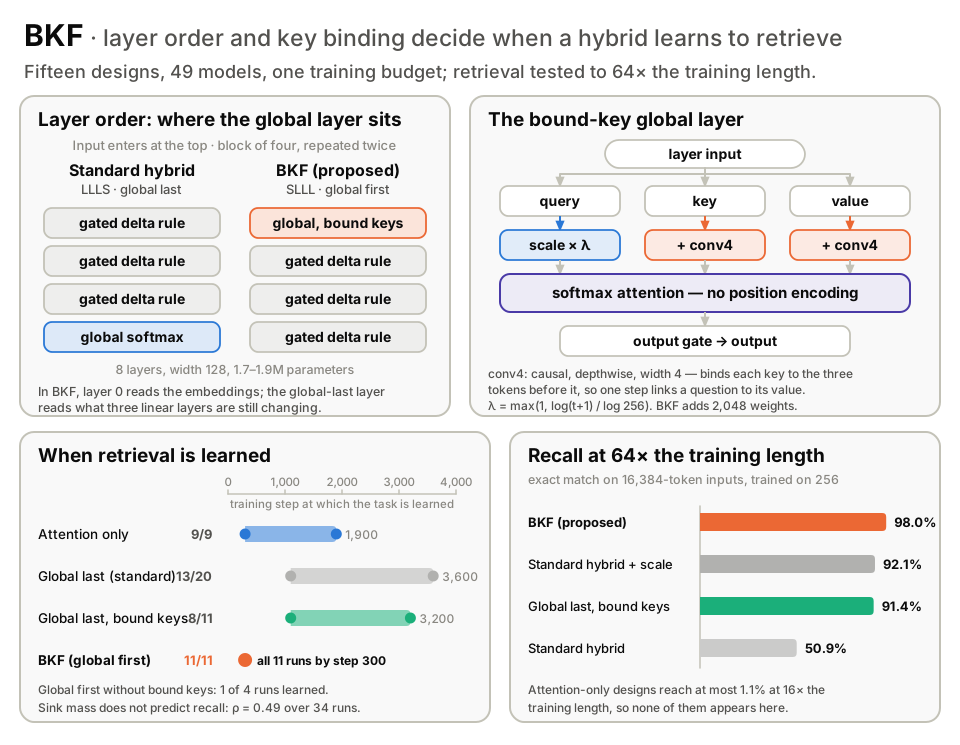
Layer Order and Key Binding Decide When Hybrid Models Learn to Retrieve
Under review, ICLR 2027
, Fahmina Taranum, Tasneem Bano Rehman, Sumrana Siddiqui, Sara Rizwan, Samaanah Abdus Salam, Quratulain Nayeem, Summaiya Unnisa Begum, Sadaf Kauser, Muzammil Shareef, Abdul Raheem Ahmed
[Project page] [Blog post]
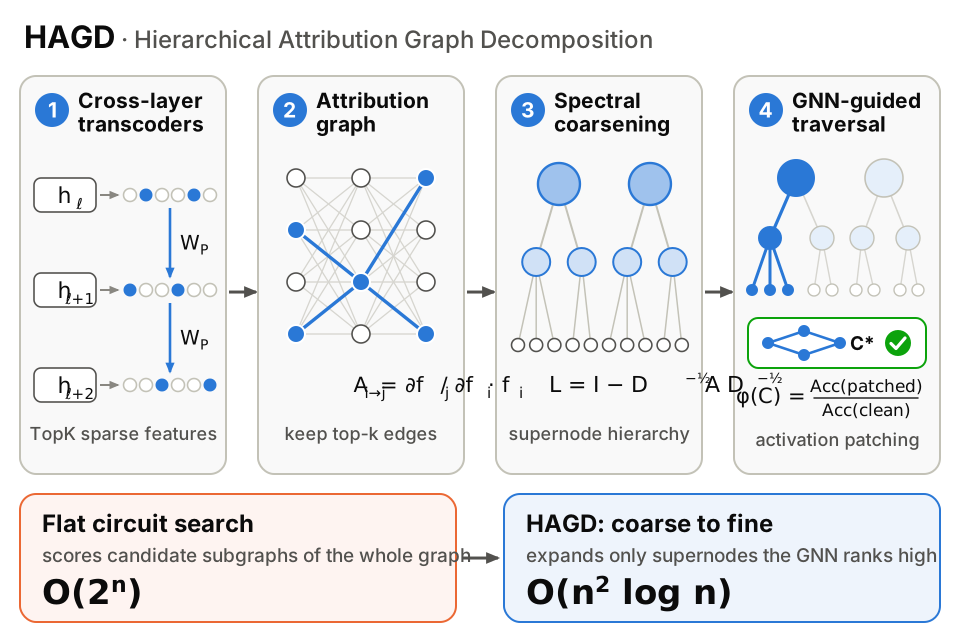
Hierarchical Sparse Circuit Extraction from Billion-Parameter Language Models through Scalable Attribution Graph Decomposition
arXiv, 2026 · accepted at Discover Artificial Intelligence
, Shahnawaz Alam, Mohammed Kaif Pasha
[Project page] [arXiv] [Code]
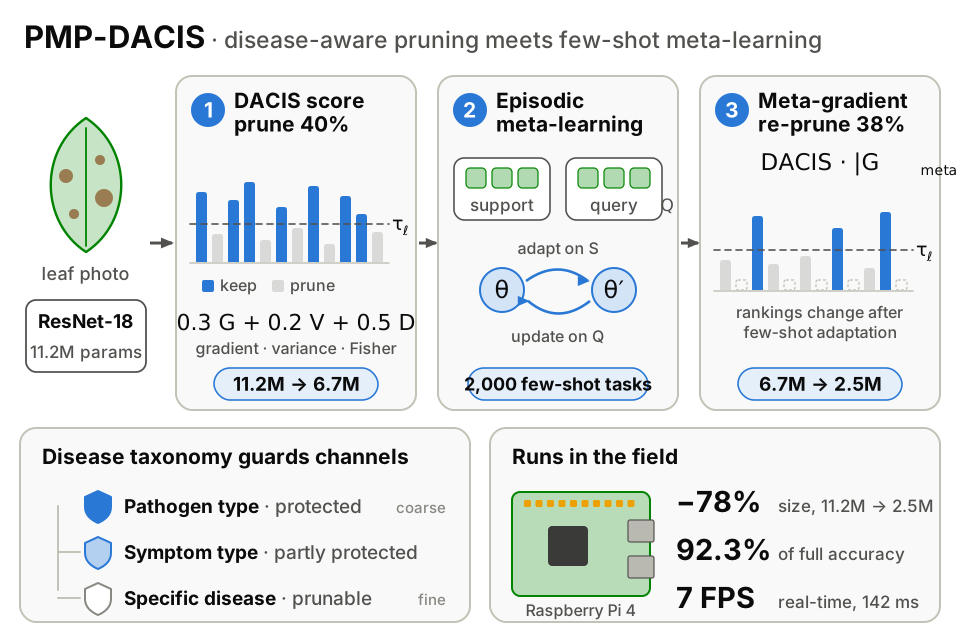
Meta-Learning Guided Pruning for Few-Shot Plant Pathology on Edge Devices
arXiv, 2026 · under review at JMLR
, Shahnawaz Alam, Mohammed Kaif Pasha, Tasneem Bano Rehman, Fahmina Taranum, Afroze Begum
[Project page] [arXiv] [Code]
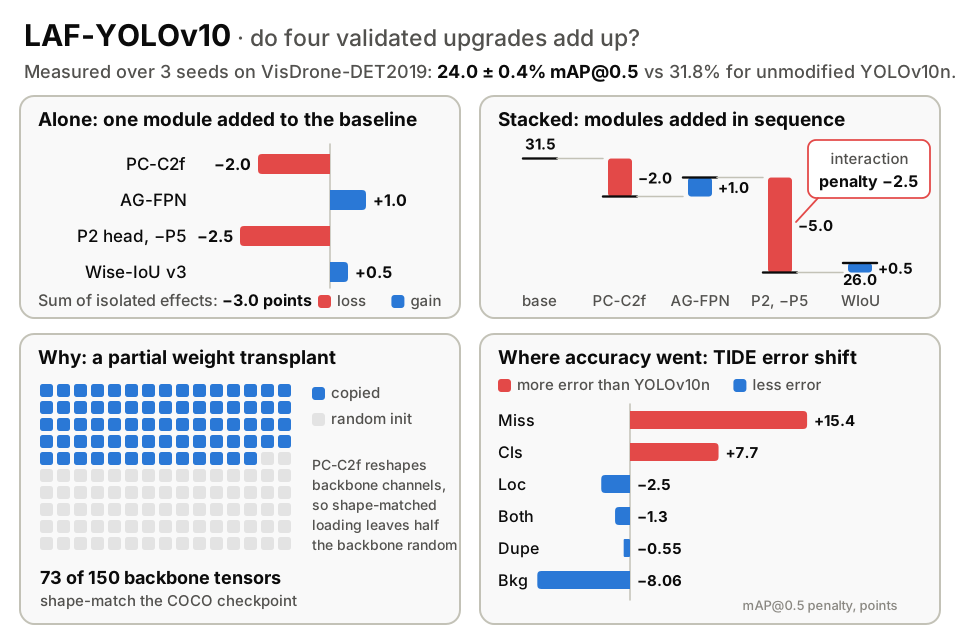
Small Object Detection in Drone Aerial Imagery with LAF-YOLOv10
arXiv, 2026
Quratulain Nayeem, Fahmina Taranum,
[Project page] [arXiv] [Code]
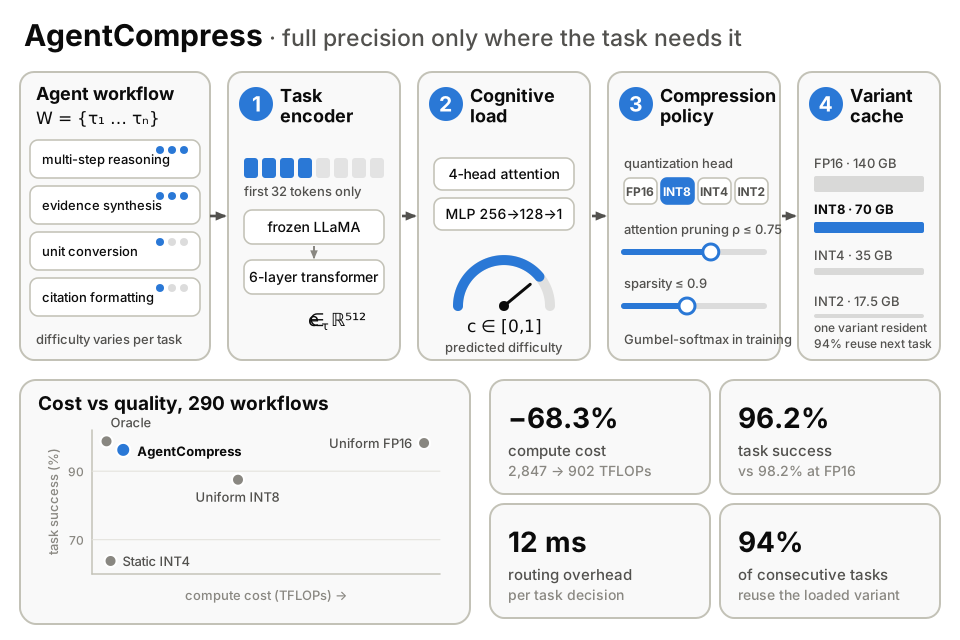
AgentCompress: Task-Aware Compression for Affordable Large Language Model Agents
arXiv, 2026
Zuhair Ahmed Khan Taha, , Shahnawaz Alam
[Project page] [arXiv] [Code]
Blog
Short notes, month by month, on what I built, what broke and what I learned. All 26 posts →
Sep 2026 Where the global layer goes decides when a hybrid learns to retrieve
Aug 2026 I audited my own paper
Research
Research Experience
-
2026 – Present Research Intern, Dr. Tasneem Bano Rehman, MJCET – IGSTC WISER Indo–German Government-Funded Project: “AI-Enabled Scout Drone for Real-Time Pest Detection and Geotagging in Precision Agriculture.” Contributing to data acquisition and working with multimodal data (RGB, thermal, LiDAR), with a particular focus on developing and exploring data and sensor fusion approaches for integrating information from multiple sensing modalities. The work detects pest-infested paddy crops, processes the imagery, and returns geospatial tags (latitude and longitude) that show which parts of a field are most affected
-
2026 – Present Visiting Research Collaborator, Prof. Hamdi Al-Jamimi, KFUPM — Verifying Glass-Box Explanations in Sepsis Clinical Decision Support. Hospitals deploy AI that recommends a sepsis treatment along with an explanation of why. This project tests whether those explanations are faithful: a piece of evidence named in the explanation is perturbed, and the recommendation is checked for the shift the explanation predicted. A recommendation that does not respond the way its own explanation claims is flagged as unreliable, however accurate the underlying prediction is. Cases are labelled by Sepsis-3 consensus criteria and validated on MIMIC-IV and the PhysioNet 2019 Sepsis Challenge, then on HiRID, a Swiss ICU cohort, to test whether faithfulness holds outside US hospital systems — a cross-institutional question almost no existing sepsis AI work has asked.
-
2024 – 2026 Undergraduate Research, Dr. Fahmina Taranum, MJCET — LLM agent efficiency, long-context architectures and TPU-native compute. Co-authored the ICLR 2027 submission on layer order and key binding in hybrid models, and co-developed the AetherState and CausalGenome-JAX proposals submitted to the Google TPU Research Awards, with Dr. Taranum as Principal Investigator on both.
-
2025 – 2026 Undergraduate Research, Dr. Tasneem Bano Rehman, MJCET — co-authored Meta-Learning Guided Pruning for Few-Shot Plant Pathology on Edge Devices (under review at JMLR). Dr. Rehman supervised the edge-deployment and few-shot methodology and contributed to the Raspberry Pi 4 experimental validation.
Research Funding Proposals
Five competitive proposals submitted in 2026, all under review, each with Dr. Fahmina Taranum (MJCET) as Principal Investigator.
-
2026 Indian Council of Social Science Research (ICSSR) — minor research project, ₹15 lakh budget.
-
2026 Google TPU Research Awards — AetherState: TPU-Native Evidence Memory and KV Cache Control for Long-Horizon Agents. Long agent runs accumulate context with nothing linking cached KV state to the evidence it encodes: a summary drifts from its source span, a KV page survives because it is cheap to reuse long after its evidence went stale, and retrieval identity sits separate from cache identity, forcing repeated prefill. The proposal makes memory a first-class object owning its source-span hash, provenance chain, retention policy and KV page metadata, with Pallas kernels and a Tunix-style controller managing the lifecycle on TPU. Target venue: MLSys 2027 · 70–100k TPU chip-hours, 20 TB storage.
-
2026 Google TPU Research Awards — CausalGenome-JAX: Perturbation-Grounded Regulatory Genome Modeling Under Leakage-Resistant Evaluation. Regulatory genomic models are evaluated under splits that share chromosome, cell-type and assay-lab structure, letting correlation stand in for causation. A model can score high correlation on chromatin and RNA tracks and still fail on the disease variant that matters, because the split let it reuse nearby sequence. The proposal freezes four orthogonal holdouts before training, then tests whether MPRA and Perturb-seq supervision improves noncoding variant-effect prediction beyond correlation-only baselines. Target venue: NeurIPS or ICML 2027 · 180–260k TPU chip-hours, 50 TB storage.
-
2026 GARA, Early Fault-Tolerant Algorithms and Applications — Circuit-Level Cost and Industrial Viability of Locally-Quantum Decoders for Decoded Quantum Interferometry, as Co-Principal Investigator with Dr. Fahmina Taranum as PI. Decoded Quantum Interferometry turns sparse combinatorial optimisation into LDPC decoding, so whether it beats classical computing comes down to the decoder. A 2026 locally-quantum decoder outperforms belief propagation at many (k, D) settings, but it has never been built as a circuit, never been costed under the FLASQ surface-code model, and nobody has checked whether real industrial problems even land in the region where it wins. This project builds the decoder in Qualtran, costs it under FLASQ, reruns the industrial ILP-to-XORSAT pipeline on it, and reports where the numbers land — including the case where the answer is that belief propagation stays the right practical choice. Six months, classical compute only, everything released under Apache 2.0.
-
2026 Amazon Research Awards — Temporal Belief State Auditing for Regulatory Compliance in Multi-Agent AI Systems. A formal framework for tracking what an agent believes about its task state over time, flagging when the accumulated belief state drifts outside the documented authorization scope. Target application: regulated financial and healthcare deployments.
Open Source
-
2026 TransformerLens, nnsight, Flower, Hugging Face datasets, skpro, movement, BrainGlobe, zfit, cabinetry, Invenio and HEPData. Twenty-nine pull requests and ten bug reports since October, each fix with tests, and ten are merged already. In TransformerLens, cached hooks kept or dropped the batch dimension depending on the code path, and a hook that returned
Nonecrashedrun_with_hooks. In nnsight, encoder-decoder models were left-padded, which shifted the logits of the short rows. In Flower, the adaptive-clipping norm moved away from its target quantile. In datasets,Dataset.shardraised on empty shards. In skpro, scalarilocand broadcast parameters crashed,Hurdlereported a variance of 3 where the true value was 25.5, and the energy ofNormalMixtureignored the component means. In movement,cart2polturned x-y-z data into polar coordinates that matched neither the plane nor the point. In BrainGlobe, interrupting an atlas download with Ctrl+C left an atlas that could not be opened or downloaded again. The rest are in review. skpro is one of the GC.OS projects in Google Summer of Code, so it is where I started for the 2027 round; movement and BrainGlobe belong to the Neuroinformatics Unit, another Google Summer of Code organisation (all pull requests). -
2026 pgmpy — 11 pull requests in February 2026 to the Python library for probabilistic graphical models and causal inference: a rewrite of
minimal_dseparatoron the moralized ancestral graph, state names lost onfit, keyword arguments dropped byquery, a NaN average treatment effect on empty adjustment sets,ApproxInferencebuilding its state space from samples instead of the model, and UAI round-trips losing variable names. Three are still open for review. -
2026 pyGAM — 4 open pull requests from March 2026 to the generalized additive modelling library: p-values and effective degrees of freedom computed with Wood's (2013) rank-r truncated eigendecomposition, overflow in link functions and wrong weights in distributions, and restoring the scikit-learn estimator contract.
-
2026 LaTeX Intelligence — an open-source VS Code extension that converts LaTeX sources into genuinely editable Word documents: equations as OMML rather than images, cross-references as live Word fields, and TikZ compiled against your own preamble or drawn as native Word shapes when no LaTeX engine is present. 153 KB packaged, 397 tests, zero runtime dependencies (source).
Experience
-
2022.12 – 2023.05 Machine Learning Engineer, RentEra — refined production ML models on real-estate rental data through feature engineering and algorithm tuning, reducing live inference error on user-facing systems. Where I learned exactly where the gap between a backtested model and a deployed one lives.
-
2022.05 – 2022.11 Junior ML Engineer, Techieyan Technologies, Hyderabad — structured exploratory data analysis and statistically validated experiments that surfaced the feature signals behind product decisions. First production ML role, started during the diploma.
Hackathons
40+ hackathons. Real products built under real pressure. Only the ones worth telling.
-
2026.02 Hack-Nation Global AI Hackathon, with the MIT Sloan AI Club (36 hours). Built AI Chief of Staff, organizational intelligence that maps real-time knowledge flow across teams. The RAG pipeline crashed at hour 22, was rebuilt by hour 26, and shipped at hour 36.
-
2025.12 Agentathon 2025, Malla Reddy University (2,300+ developers, Guinness World Record). Built fraud-detection agents for public-spending transparency. The record was a bonus; the lesson was humility.
-
2025.12 ElevenLabs Worldwide Hackathon, at NxtWave (Voice AI). Built a “Netflix of corporate training”: upload a PDF and get back bite-sized, AI-narrated video episodes.
-
2025.11 IBM watsonx Orchestrate Hackathon, LLM Security Track. Built Guardian-AI, a constitutional AI security layer for LLMs in SOC environments. The adversarial cases we didn’t think of were the ones that mattered most.
-
2025.01 #7Days7Builds Challenge, built in public. Seven deep CS projects in seven days: a BitTorrent client, a blockchain in C#, a 3D engine from scratch, and semantic code search.
Education
-
2023 – 2026 B.E. in Computer Science and Engineering, Muffakham Jah College of Engineering and Technology (affiliated to Osmania University), Hyderabad. CGPA 7.99/10, with a final-year focus on AI systems, distributed computing and machine learning theory. Joined in the second year after the diploma.
-
2020 – 2023 Diploma in Computer Science, State Board of Technical Education and Training (SBTET), Telangana. 80% grade; started freelancing and billing clients for code at 17.
Ventures
-
2026 – Present Stealth: Indian AI Dataset Infrastructure (In Progress). India has 1.4 billion people and almost no representative AI training data for its regional languages, healthcare, legal, agriculture, and cultural domains. I am building collaborative AI agents that structure these missing datasets natively on TPU clusters. Related open-source work: the Federated Regional Data Infrastructure collection node for Telugu, Tamil, Hindi, and Bengali, where raw text never leaves the device it was typed on.
-
2026 – Present Vak (In Progress) — an open-source AI literacy and interpretability platform built natively in Telugu and Hindi. Over 600 million Telugu and Hindi speakers interact with AI systems that decide on their healthcare, loans and job applications, and none of the tooling that shows developers what those systems are actually doing exists in their language or at their hardware budget. Vak builds voice-accessible interpretability on Sarvam AI's STT, TTS, LLM and translate APIs; the first version runs behavioural audits of LLM outputs in Telugu, built for how Telugu speakers frame questions and what Telugu models get wrong. Accepted into the Sarvam AI Startup Program (July 2026) with ₹25,000 in credits and full API access.
-
2025 Auragenzy — founder and research head. I led the team's technical and research work on an AI SaaS for no-code workflow automation: the agent orchestration and evaluation stack, the internal research that decided what to build, and the parts of the model tooling we open-sourced. Real paying users within months of launch.
-
2022 Brevenia — social media growth agency, co-founded at 17. Zero funding, cold outreach, first payroll.
Certifications
-
2026 Claude Certified Architect – Foundations, Anthropic (score 944/1000)
-
2026 Claude Certified Architect – Early Adopter, Anthropic
-
2026 Neo4j Graph Data Science Certification, and Neo4j and Generative AI (LLM Fundamentals), Neo4j GraphAcademy
-
2026 CS50x, Harvard University
-
2023 Neural Networks and Deep Learning, and TensorFlow for AI, ML and Deep Learning, DeepLearning.AI
-
2023 Data Science Professional Certificate, and Statistics for Data Science with Python, IBM
-
2023 SQL for Data Science, and Fundamentals of Visualization with Tableau, UC Davis
-
2023 Preparing Data for Analysis with Microsoft Excel, Microsoft
-
2023 IT Automation with Python Professional Certificate, Google
Others
Recommendation Letters
-
Recommendation letter from Dr. Tasneem Bano Rehman, Assistant Professor, Department of Computer Science and Engineering, Muffakham Jah College of Engineering and Technology (MJCET), Osmania University.
-
Recommendation letter from Dr. Fahmina Taranum, Professor, Department of Computer Science and Engineering, Muffakham Jah College of Engineering and Technology (MJCET), Osmania University.
-
Recommendation letter from Prof. Hamdi Al-Jamimi, Associate Professor, Department of Computer Engineering, King Fahd University of Petroleum and Minerals (KFUPM), Saudi Arabia.
Mission & Community
-
My long-term mission is Vak, an open-source AI literacy and interpretability platform built natively in Telugu and Hindi. More than 600 million Telugu and Hindi speakers deal with AI systems that decide their healthcare, loans and job applications, and none of the tooling that shows what those systems are actually doing exists in their language or at their hardware budget. Vak builds voice-accessible interpretability on Sarvam AI's STT, TTS, LLM and translate APIs. I am open to collaborating with researchers, NGOs and language-technology groups on it.
-
I build in the open: 60+ public repositories on GitHub, and an organic community of about 16k on LinkedIn.
Mentors & Collaborators
The supervisors, mentors and collaborators behind the work:
-
Dr. Fahmina Taranum (MJCET, Osmania University) — my primary supervisor through undergrad, PI on the research proposals, co-author on the ICLR 2027 submission, LAF-YOLOv10 and the plant pathology work.
-
Dr. Tasneem Bano Rehman (MJCET) — the edge deployment and few-shot methodology on the plant pathology paper, and co-author on the ICLR 2027 submission.
-
Prof. Hamdi Al-Jamimi (KFUPM) — supervises the sepsis explanation-faithfulness work.
-
Sadaf Kauser (BITS Pilani, Dubai Campus) — the ICLR 2027 submission.
-
Muzammil Shareef (Athabasca University, Canada) — the ICLR 2027 submission.
-
Abdul Raheem Ahmed (Wilmington University, United States) — the ICLR 2027 submission.