On 13 September we posted Small Object Detection in Drone Aerial Imagery with LAF-YOLOv10. Quratulain Nayeem is the first author, with Dr. Fahmina Taranum and me.
Drone footage is hard for general-purpose detectors: targets span a handful of pixels, and onboard compute is small. The common recipe is to take techniques that each worked in their own paper and combine them. We did that with four: a partial-convolution backbone block (PC-C2f), an attention-guided feature pyramid (AG-FPN), a stride-4 detection head in place of the large-object head, and Wise-IoU v3 regression. Then we tested whether the gains add up.
They don't
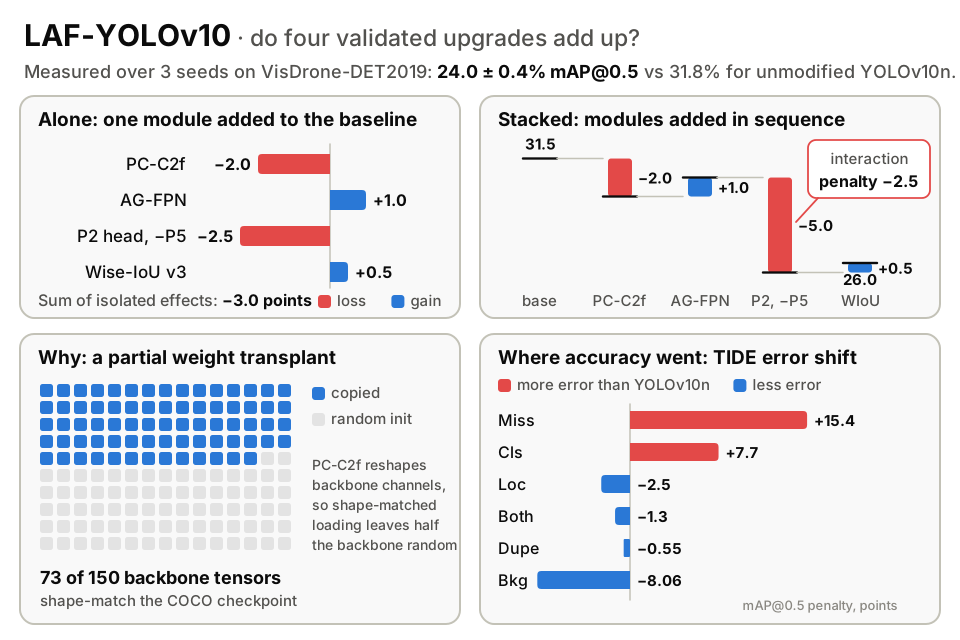
Over three seeds on VisDrone-DET2019, LAF-YOLOv10 reaches 24.0 ± 0.4% mAP@0.5 at 2.14M parameters, against 31.8% for plain YOLOv10n. The deficit carries over to UAVDT, where it is 10 points, and holds on the held-out and test-dev splits.
The diagnosis
The failure is not uniform. Background false positives, localisation errors and duplicate detections all move in the direction AG-FPN and Wise-IoU were designed to push. The deficit sits in missed detections and class confusion, concentrated on vans, trucks, buses and awning tricycles: the medium-to-large vehicles the removed head used to cover.
Ablation puts 2.5 points on the head swap alone and another 2.5 on its interaction with the backbone. The backbone is weakened because, once PC-C2f changes its channel layout, only 73 of 150 pretrained tensors transfer. That last point is the leading hypothesis, not a tested one, and a controlled run is the first item of future work.
Composability has to be tested, not assumed. The checkpoints for all three seeds are in the repository, and the project page has the detection examples.